Chi for Two® developmental relational practices: A lens for examining how somatic therapy might resolve infant reflexes
Originally published online June 17, 2025, in Body, Movement and Dance in Psychotherapy, Taylor & Francis https://doi.org/10.1080/17432979.2025.2517612
*Article uses British spelling and punctuation per journal’s editorial guidelines
Authors: Dee Wagner, Caroline Gebhardt
Abstract
Chi for Two provides a sequence of two-person practices that replicate key infant/parent interactions. This review of science supporting this method could encourage studies developing anatomical understanding of how somatic therapy might resolve infant reflexes. Chi for Two synthesises polyvagal understanding of multi-generational trauma including infant developmental movement and mindfulness of rhythm in the therapeutic dance. When we sense safety, the rhythm of the firing and refractory period of the myelinated vagus at the brainstem facilitates the pharynx’s coordination of breathing and swallowing; the rhythm of the firing and refractory period of the unmyelinated vagus facilitates gut motility, which makes deeper breathing possible. The striatum channels reflexive movement into goal-directed movement such as Reach, Grasp, Pull and Push—moves that during infant/parent interactions develop into gestures. Multi-generational trauma patterning might cause parents’ unresolved reflexes to reappear during child/parent interactions, making it difficult for parents to provide the holding space that resolves the infant reflexes of the next generation, but somatic therapy could provide the re-patterning.
Keywords: infant reflexes, polyvagal, somatic interventions, dance/movement therapy, multigenerational trauma, striatum
Introduction
Infant reflexes are automatic movements that develop in the womb to help us survive and grow. These reflexive movements stop happening as goal-directed movement develops (Modrell & Tadi, 2023). When the movements stop happening, the infant reflex is said to have resolved or disappeared. Chi for Two is a mindful embodiment method that offers a sequence of relational practices for clients to do with a Chi for Two Embodiment Coach, which replicate key infant/parent developmental interactions (Wagner, et al., 2024). There are also practices that help clients have more satisfying peer relationships. However, for the purpose of this paper, we focus on Chi for Two practices that create a symbolic redo of infant/parent interactions, which pattern nervous system functioning because knowledge of those practices might encourage research, which could help somatic therapists recognize how somatic therapy resolves infant reflexes. There is a curriculum for teaching Chi for Two, which is approved by the International Somatic Movement Education and Therapy Association (ISMETA).
The Chi for Two perspective on polyvagal theory and multi-generational trauma could clarify the difference between the resolution and the disappearance of infant reflexes leading to greater understanding of goal-directed movement. Goal-directed moves like Reach, Grasp, Pull and Push are key in the dance of communication. With the anatomical understanding foundational in the Chi for Two method, resolution of infant reflexes could be seen as occurring when goal-directed movement achieves the goal of individuation within the dance of relationship. For instance, the palmar grasp reflex might resolve into a goal-directed movement like Push when the infant’s Push away of a spoon offered by a parent is celebrated by the parent, “Oh, I just noticed, you are busy trying to get your pea to balance on your carrot square!” As noted throughout the paper, the disappearance of infant reflexes and reappearance later in life could be seen as multi-generational trauma patterning in need of healing (Wagner & Waisman, 2023).
Chi for Two – a mindful embodiment method
Chi for Two was originated by author Wagner and co-developed by author Gebhardt, Wagner’s son, Stephen Wagner, a tai chi teacher; and Mary Lou Davidson, a massage therapy educator and musician. Three of Wagner’s four journal articles include co-authors; dance/movement therapists and educators Stacey Hurst (2018); and Orit Sônia Waisman (2023); couples therapist, somatic therapist and Chi for Two Embodiment coach and Trainer, Mukti Jarvis; plus, Chi for Two Embodiment Coach and director of diversity marketing, Fred Shelton (2024). This review examines the anatomical information presented in these articles, bringing in deeper understanding of the vagus provided by other sources, selected because these other sources offer anatomical details that illuminate vagal and striatal functioning.
Because the striatum channels random movement into goal-directed movement, understanding of striatal functioning along with vagal functioning offers anatomical support for long-used somatic and expressive dance/movement therapy methods, supported mostly by qualitative studies at this point (Wagner & Hurst, 2018; Wagner & Waisman, 2023). The synthesis of vagal and striatal knowledge with somatic and expressive dance/movement therapy methods invites the possibility of quantitative study for future research.
Chi for Two provides a measurable protocol by offering practices in the way that yoga offers practices. Trauma researcher Bessel van der Kolk speaks to the value of expressive arts therapies in his book The Body Keeps the Score (2014), but names the difficulty of the measurement of their effectiveness, recommending yoga for trauma healing. Because vagal functioning depends on the rhythm of the firing and refractory period of the vagus nerve, vagal awareness adds important information to the infant developmental work of child psychiatrist Judith Kestenberg and colleagues mostly studied by dance/movement therapists and synthesised into Chi for Two (Wagner et.al., 2024). Kestenberg and colleagues identified developmental infant tension flow rhythms, which are related to sucking and biting (Kestenberg Amighi et.al., 1999). Sucking and biting are infant movements that are very affected by the rhythm of firing and refractory period of the myelinated branch of the vagus nerve at the brainstem (Breit, et.al., 2018). Biting movement is key in spoken language (Wagner, et.al., 2024). Knowledge of the infant ‘fighting’ rhythms and their role in individuation within the dance of the infant/parent relationship helps motivate individuals and families to do the Chi for Two therapeutic practices (Wagner, et.al., 2024). Quantitative study based on the growing body of evidence supporting this developing method could bring better understanding of the role of the somatic therapeutic dance in the resolution of infant reflexes.
Vagal and striatal understanding as support for Chi for Two
The two articles chosen for providing details of vagal functioning support the use of devices that stimulate the vagal nerve. These vagal nerve stimulator devices were first used to treat conditions like epilepsy and are now being explored for other diagnoses (Breit et.al., 2018; Neuhuber & Berthoud, 2022). The fact that the articles support devices, which affect the rhythm of firing and refractory period of the vagus adds an additional layer of information. Chi for Two polyvagal understanding focuses on patterns of firing and refractory period of the two major branches of the vagus. Simply the fact that vagal stimulation devices affect the rhythm of firing and refractory period supports the Chi for Two focus on the rhythm of vagal functioning.
Infant/parent developmental movement toward communication
As we explore the possibility of the resolution of infant reflexes through the lens of Chi for Two, we can look at four infant reflexes:
Spinal Galant Reflex – C-curve side-to-side movement like a fish, which infants use in coming down the birth canal and for the birth crawl.
Palmar Grasp Reflex – Newborn’s hands will grasp unconsciously. This human reflex is a remnant of the hand movement that other mammal babies use to hold onto their mother’s fur to stay connected to them.
Plantar Reflex – The infant’s toes react in response to stimuli. When unresolved, this reflex can lead to toe walking—walking on the balls of the feet.
Moro Reflex – The infant flings its arms out to the side spreading the fingers on both hands.
The spinal Galant, palmar, plantar, and Moro reflexes are movements that ideally stop happening as goal-directed movement develops (Modrell & Tadi, 2023). Bonnie Bainbridge Cohen, creator of Body-Mind Centering® identified infant movements, which can be seen as goal-directed movements. Four of those movements are Reach, Grasp, Pull and Push (Bainbridge Cohen, 2018). As infants, we ideally become able to Reach out to parents for interaction that creates rhythms of nervous system patterning, which facilitates well-being. When infants can Reach purposefully toward parents, infants’ palms open their reflexive grasping and goal-directed grabbing, pulling, and pushing can begin to develop.
These moves, Reach/Grab/Pull and Push can be seen in gestures that seek interaction within the dance of communication. Ideally even a jerky Reach communicates a wish to connect that parents can react to with delight. Unfortunately, the percussive nature of infant reflexes might interfere with the resolution of reflexes within the infant/parent dance of communication (Wagner & Waisman, 2023). From the work of Judith Kestenberg and colleagues, creators of the Kestenberg Movement Profile (KMP), we know that the rhythm of movement expression affects infant/parent interactions. (Kestenberg-Amighi et al., 1999). Dance/movement therapist Susan Loman, one of the colleagues working with Kestenberg, gives examples of how KMP knowledge can help parents in her article Judith S. Kestenberg’s dance/movement therapy legacy: Approaches with pregnancy, young children and caregivers (2016). KMP rhythms alternate between ones called ‘indulging’ and ones called ‘fighting’. The first four alternating rhythms are ‘sucking’ (indulgent), ‘biting/snapping’ (fighting), ‘twisting’ (indulgent), and ‘straining/releasing’ (fighting) (Kestenberg-Amighi et al., 1999). The ‘indulging’ rhythms seek a match with parent rhythms. Movements with the ‘fighting’ rhythms mismatch with parent rhythms as infants’ percussive and oppositional squirmy movements within parents’ supportive holding helps infants establish a sense of separate being. (Wagner & Waisman, 2023).
Tronick and Gold speak to the organic nature of the dance of mismatch in their book, The Power of Discord: Why the ups and downs of relationships are the secret to building intimacy, resilience, and trust (2020). In 2010, Waisman studied mismatch of gesture and word during situations of conflict between Israeli-Arab and Israeli-Jewish students. In Waisman’s article with Wagner, they note the work of Susan Goldin-Meadow and colleagues who noticed mismatch between words and gestures occurring during transitions in children’s learning process (2023). When parents are comfortable with both the ‘indulging’ and ‘fighting’ types of rhythms, infants can Reach toward parents purposefully seeking the kind of holding support that helps them work through distress.
Reach can lead to goal-directed Grab/Pull and Push, evolving into gestures that begin to draw sounds out of the body making the gestures more communicative (Rossini, 2012). Movement of mouth and teeth and tongue, very affected by the rhythm of the firing and refractory period of the myelinated vagus at the brainstem, begins to sculpt sounds into words adding more possibilities for infant/parent interaction.
When infants can make actions, which receive useful reactions from parents, it is likely that the survival need for the reflexive movements no longer exists (Wagner et.al., 2024) because those random movements have been channelled into goal-directed movement (Modrell & Tadi, 2023). When this happens, the infant reflexes could be said to have been resolved. Dancers Pesso and Boyden created a therapeutic system for emotional reprogramming called Pesso Boyden System Psychomotor (PBSP). PBSP trainer Gus Kaufman, Ph.D. supervised Wagner’s origination of the Chi for Two method. Kaufman teaches, ‘Emotion is motion in the body; Motion causes Action; Action is designed to get a reaction’ (personal communication, April 8, 2000, as reported in Wagner et.al., 2024). From the PBSP perspective, when infant actions receive no parental reaction, the infant actions may be repeated with growing desperation. When infant action is shamed (directly or indirectly), the infant action disappears. Current understanding of the vagus and striatum suggest that when parents’ reactions to children’s actions confound children, this dance is likely to shift the rhythm of the firing and refractory period of the mostly unmyelinated branches of the vagus nerve in the gut, affecting digestion and breath and likely the functioning of the striatum.
Resolution of infant reflexes is likely the result of infants’ goal-directed action receiving parent reaction that validates that infant action. When infant reflexes do not resolve in infancy, they may disappear. Percussive flailing of infant limbs in search of the support of parental arms may stop flailing without the parent discovering how to make their arms available to support the infant’s movement. This disappearance of movement expression can be seen as trauma because trauma is an inhibition of movement. (Levine, 2017). We know from the multi-generational trauma understanding of Resmaa Menakem, author of My grandmother’s hands: Racial trauma and the pathway to mending our hearts and bodies, as well as other trauma experts, that parents’ reactions to their children’s actions are patterned over many generations. Change comes in mindful practice (Menakem, 2017). The reappearance of infant reflexes after their disappearance could be seen as the multi-generational trauma patterning in which inhibited movement awakens seeking the possibility of a validating reaction.
Multi-generational trauma
Trauma is an inhibition of movement due to a sense of danger (Levine, 2017). Both the development of a connection with a parent when we cannot walk and get water, food and shelter for ourselves as well as the development of a sense of sustainability as a separate being within that parental connection are life-dependant accomplishments for children (Wagner & Waisman, 2023). Therefore, both the inhibition of certain infant movement expressions at certain developmental periods, as well as the desperate reawakening of those movement expressions later in life, make sense as life-sustaining multi-generational trauma patterning. An infant’s Push into parents that results in the infant being putting down rather than being held could lead to inhibition of infant reflexes that make Push possible. Later, the child might shove the parents whenever the parents start disappearing into their phones, which could prompt the parents to seek help for the family. It makes sense that the infant reflexes would become inhibited when parents’ reactions cannot validate infants’ actions because parents received no validation when they were infants themselves. It also makes sense that unresolved infant reflexes would reawaken later in life seeking the resolution that allows each person to sense their unique being because our bodies function better when core-to-distal movement flow is available to us (Wagner & Waisman, 2023). Multi-generational trauma patterning explains the difference between infant reflexes that seem to disappear and reappear later in life versus those that resolve during infancy because the definition of trauma is an inhibition of movement (Levine, 2017).
Recognising trauma as an inhibition of movement is key in the method Chi for Two (Wagner et.al., 2024). When mammals are trapped in situations of life-threatening danger with no ability to flee or fight, they inhibit movement using biological functioning that scientist Stephen Porges refers to as dorsal vagal Shut-down (2011). If there becomes a possibility of escape, mammals shoot off the chemistry that creates the Fight or Flight response to awaken the inhibited movement and flee the danger or fight if they must (Levine, 2017). If the animal makes it to a place of safety, the animal moves in ways that work out the remaining Fight/Flight chemistry. If the inhibited movement is awakened with the accompanying Fight/Flight and if upon finding safety all the chemistry of the Fight/Flight response is worked through the body, there is no trauma (Levine, 2017). When this biological process has not completed and movement remains inhibited, that is trauma (Levine, 2017; Wagner & Waisman, 2024; Wagner, et.al., 2024).
Menakem as well as other trauma experts provide support for the growing awareness that movement inhibition can be passed down over generations (2017). Multi-generational trauma interferes with parents’ ability to provide the kind of holding support that allows the next generation to work distress through and out of their bodies (Wagner & Waisman, 2023). When infants can purposefully squirm side-to-side within the holding support of parents, this movement has the ‘straining/releasing” rhythm identified in the KMP. This c-curve side-to-side squirming is the spinal Galant infant reflex. ‘Straining/releasing’ is the second ‘fighting’ rhythm (Kestenberg Amighi, et.al., 1999). Without parental holding support, infants’ squirmy movement can become inhibited by dorsal vagal Shut-down. The rhythm of engagement and release of the dorsal vagal nerve—a major nerve in the belly—gets sluggish (Wagner & Waisman, 2023).
Sluggish rhythm of firing and refractory period of the mostly unmyelinated branches of the vagus nerve in the gut can slow digestion and shallow breathing likely causing the flow of energy from the core of the body out to hands and feet to lessen, which could cause the palmar and plantar reflexes to seem to disappear. When reflexes disappear rather than resolving during infant/parent interactions, they might reappear seeking resolution but presenting as attachment issues. For instance, parents can throw their hands up and out, retreating to avoid interaction. Recognition of this Moro infant reflex in the parents, and resolving it somatically in developmental relational practices with a helping professional, could resolve this problem multi-generationally.
Understanding of dorsal vagal functioning helps professionals provide therapeutic interventions for individuals and families. For instance, when parents can sense in their own bodies how the reappearance of infant reflexes is a seeking of the resolution of that reflex, they can practise interventions with helping professionals with conscious awareness of multi-generational trauma patterning. Then they are more capable of practising similar interventions with their children. As multi-generational trauma patterning is re-patterned and infant reflexes resolve into goal-directed movement, gestures could better support words (Wagner & Waisman, 2023).
Dorsal vagal shut-down
The vagus nerve is the tenth and longest cranial nerve. It affects the other cranial nerves and then descends through the torso with many branches in the area of the heart and the digestive system (Porges, 2011). Vagus means wandering. The vagus wanders through the body affecting various parts of the body based on the rhythm of its functioning. (Wagner & Waisman, 2023; Wagner et.al., 2024).
The myelinated (sheathed) ventral (front) branch of the vagus nerve affects all the other cranial nerves that are part of infant/parent interactions and the communicative aspects of those interactions. It affects the flexing of the middle ear muscle to focus on the human voice, the facial muscles that create expressions, the movement of eyes, turning of the head and vocal patterning. The anatomical effect on communication provided by the rhythmic firing and refractory period of the myelinated vagus at the brainstem is why Porges named this neural circuit our Social Engagement system.
The unmyelinated (unsheathed) dorsal (back) branch of the vagus travels down the body affecting digestion and depth of breath (Porges, 2011). When the rhythmic firing and refractory period of the mostly unmyelinated branches of the vagus in the gut facilitate the moving and mixing of the content of the intestines, the pelvic floor is more likely to be patterned to go down on the inhale deepening the breath for greater oxygenation of the blood. When the rhythm of the vagus in the pelvis gets sluggish, and peristalsis becomes dysfunctional to varying degrees, certain movement expressions in certain situations can become inhibited. This inhibition of movement is what Porges called Shut-down (Wagner, et.al., 2024).
The two overviews of anatomy offered here describe the vagus’ role in digestive functioning. (Breit et al., 2018; Neuhuber & Berthoud, 2022). Both overviews speak to the ventral vagus playing a role in the pharynx’s coordination of breathing and swallowing, key when the umbilical cord is cut. It is likely that ventral and dorsal both affect drooling because of the ventral’s facilitation of the pharynx’s coordination of breathing and swallowing and because of the dorsal’s likely role in sucking the spit down the oesophagus (Neuhuber & Berthoud, 2022). In the pelvis, the dorsal facilitates the moving and mixing of the content of the intestines (Breit, et al., 2018; Neuhuber & Berthoud, 2022). Sluggish rhythm of the vagus in the gut interferes with digestion and over time patterns the pelvic floor to rise on the inhale causing breathing to get shallow (Wagner, et.al, 2024). Difficulties with digestion and shallow breathing inhibit movement expression because movement expression flows outwardly from the core of the body to the limbs and head (Wagner et al., 2024). Bainbridge Cohen, like other somatic movement specialists, talks about the organic nature of core-to-distal movement—Navel Radiation (2018).
Core-to-distal flow of movement can be recognised in all the infant reflexes. Perhaps core-to-distal movement is most visible in the Moro reflex where infants’ legs extend as their arms fling out with hands spread. After the core-to-distal extension, the infant’s arms and legs pull back in toward their core. With the spinal Galant, readers could explore the side-to-side C-curve fish-swimming movement of that reflex and the movement exploration might make it possible to feel that the origin of that movement is in the core. Knowledge of the role of dorsal vagal Shut-down in the inhibition of movement (Wagner et al., 2023) can help to reveal the core-to-distal flow of movement in all the infant reflexes. Inhibition of movement due to sluggish rhythm of the vagus in the pelvis causes efforts toward goal-directed movement to disappear. There is no Reach toward parents and thus their palmar reflex disappears. There is no Push into parents and thus the plantar reflex disappears.
When reflexive movements disappear, they can reappear presenting as behaviour concerns like non-verbal and verbal tics, self-stimulating movements, or other confusing movement expressions. When professionals have knowledge of vagal functioning and how that might relate to the striatum, that knowledge can make reappearing infant reflexes more understandable. The striatum is a structure beneath the cerebral cortex, which uses acetylcholine and dopamine for programming motor movement (Jamwal & Kumar, 2019). Neuhuber and Berthoud talk about dorsal vagal nerve cells that are cholinergic—nerves that use acetylcholine as a neurotransmitter. They talk about dorsal vagal functioning affecting the digestive system in the oesophagus (Neuhuber & Berthoud, 2022). The resolution of infant reflexes into goal-directed movement could be seen as a programming of motor movement when we factor in multi-generational patterns of infant action and parent reaction.
The striatum would be key in the resolution of infant reflexes because the striatum facilitates the channelling of random movement into goal-directed movement. However, the authors propose that it is the parental response to the infant’s attempts at goal-directed movement that determines whether the infant reflex resolves or disappears. Parental responses are patterned over generations; parental responses to the next generation’s attempts at goal-directed movement are patterned in the parents’ interactions with their parents during the parents’ infancy. Social systems influence infant/parent interactions. For instance, an infant’s percussive kicking movement while held in the arms of a parent might cause a parent to provide looser holding at a time when the infant’s movement would benefit from more solid holding. Solid holding lets the infant’s random leg movements channel into Push into the parent’s arm. A grandparent who survived poverty by immobilizing Reach/Grab/Pull might encourage the parent to put the child down because, “Obviously, the child needs to figure this out on its own.” Understanding multi-generational trauma patterning from the perspective of vagal functioning helps professionals help individuals and families find empathy for the process of re-patterning the nervous system through practices (Menakem, 2017).
Healing
Trauma expert Peter Levine explains the Fight/Flight reaction, which accompanies the awakening of inhibited movement (2017). Chi for Two practices invite awareness of this patterning over generations (Wagner, et.al., 2024). Parents are invited into the two-person practices—the parent with a Chi for Two Embodiment Coach. Practising with a coach allows parents to sense how parental reactions help infant reflexes channel into goal-directed movement. This helps parents’ ability to sense when their children’s actions are awakening the parents’ inhibited infant reflexes. Doing these mindful practices with a Chi for Two Embodiment Coach, parents can sense that movements become inhibited because those movements are not safe in certain situations with certain people. As parents are invited to do these key developmental movements, one movement at a time, in this therapeutic two-person ‘dance,’ there is a Fight/Flight questioning ‘Could it possibly be safe to move this way now?!’ This personal recognition helps parents understand when their older children have a lot of movement inhibited. Children’s movement remains inhibited to avoid the Fight/Flight that is part of risking the possibility that the movement might be safe to try now. Interventions with helping professionals can replicate ideal infant/parent interaction (Wagner, 2015). Once this replication happens for parents in their ‘dance’ with helping professionals, parents can better hold supportive space to practise interventions with their children. Interventions that provide the somatic answer, ‘Yes, it is safe to move this way now, here with me,’ can shift the mobilisation of specific movement expressions from Fight/Flight to what Porges called Play/Dance.
Understanding family dynamics from the perspective of embodied symbolic re- patterning used in PBSP and awareness of the therapeutic dance within other somatic and expressive dance/movement therapy methods helps individuals and families heal trauma. In 1942, dance/movement therapist Marian Chace began exploring ‘Dance for Communication’ at St. Elizabeths Hospital in Washington, D.C., a federal psychiatric hospital before the advent of psychotropic drugs. What Chace called kinaesthetic empathy is built into the Chi for Two method. Dance/movement therapist Janet Adler worked with the idea of a mover and a witness in a technique called Authentic Movement (Stromsted, 2009). Adler’s spiritual focus invited a kind of mindfulness that is central in the Chi for Two method. The development of mindful embodiment creates more movement in more situations with more people mobilised by Play/Dance.
Mobilisation with Play/Dance
The word ‘mobilisation’ is defined in two ways. One definition draws from military ideas of moving troops. However, the other definition is ‘the action of making something capable of movement’. Porges speaks of an active state provided by the ventral vagus called Play/Dance (Porges, 2011). Play/Dance can be overlooked as a form of mobilisation. However, when we feel safe, in certain situations, with certain people it is Play/Dance that makes movement possible (Wagner & Waisman, 2023).
In the reality of our world today, only some people have some movement expressions in some situations with some people that can be mobilised with Play/Dance (Wagner, et.al. 2024). Most people have many movement expressions in many situations with many people, which have become inhibited by dorsal vagal Shut-down (Wagner et al., 2024). The very existence of a therapeutic technique called Authentic Movement names the fact that most people do not move authentically. As two-person somatic therapy interactions like Chi for Two client/therapist practices help clients develop core-flowing movement with both ‘sucking’ and ‘bite/snap’ rhythms, clients expand the movement vocabulary available to them mobilised by Play/Dance (Wagner & Waisman, 2023). Through the lens of Chi for Two, we might recognise the disappearance of infant reflexes as multi-generational trauma and see how somatic therapists can help families when the infant reflexes reappear. Families could understand that reappearing infant reflexes are mobilised with Fight/Flight because the reflexes became inhibited by a sluggish rhythm of the vagus in the gut. Patterns of infant/parent interaction over generations can lead to a lack of parental reaction to infant efforts to communicate through goal-directed movements like Reach/Grab/Pull and Push. When parents can experience the needed parental reactionary support from the coach, they can be coached to provide that support for the next generation.
Here are the four infant reflexes and the names of Chi for Two practices, which might help to resolve the reflex:
Spinal Galant Reflex – Side-to-side C-curve movement like a fish, which infants use in coming down the birth canal and for the birth crawl. If after birth the baby can be skin-to-skin on the mother’s belly, this C-curve side-to-side movement creates a birth crawl toward the breast. The Chi for Two practice Jaw Transformations offers help for resolving this reflex because it replicates the transition between Womb and the parental arm holding that is part of swaddling. Using reflective movement and vocal patterning, Embodiment Coaches invite clients through side-to-side C-curve movement first led by the top of the head as happens in the birth canal and then led by the nose as happens when the birth crawl is possible. Clients are invited to listen for the voice of the coach and look toward the coach as the coach describes the Jaw Transformations. The coach describes the shift from when the ‘jaw’ is the umbilical cord in the centre of the body to the ‘jaw’ becoming the nose and mouth. Finally, clients are invited to combine the side- to-side C-curve movement with a mindful Reach/Grab/Pull toward the Coach. Coaches’ voices invite the flexing of the client’s middle ear muscle, reminding clients that the ventral vagal nerve helps the pharynx coordinate breathing and swallowing, so important once the umbilical cord is cut.
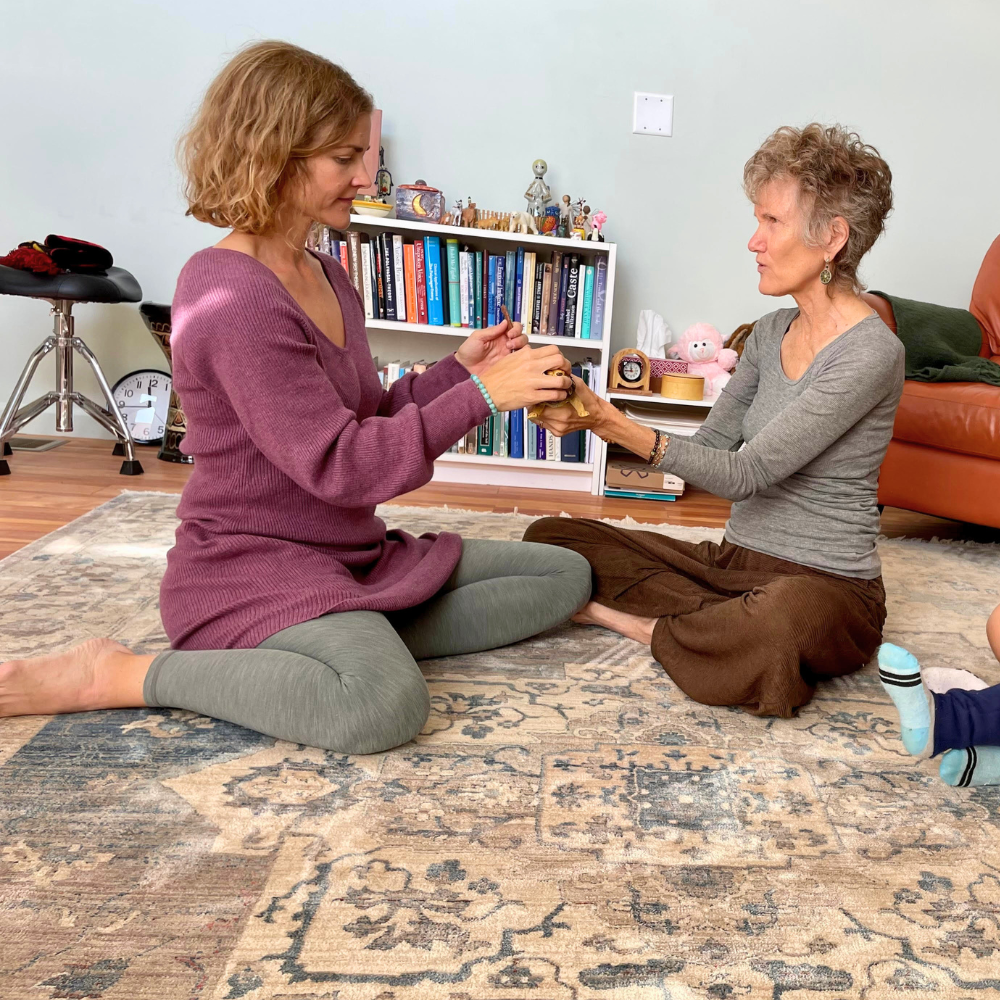
Palmar Grasp Reflex – Infants hands will grasp unconsciously. This human reflex is a remnant of the hand movement that other mammal babies use to hold onto their mother’s fur to stay connected to them. The Chi for Two practice Push offers help for integrating this reflex. Embodiment Coaches might invite clients to bring both hands forward and push the palms of their hands into the palms of the hands of the Embodiment Coach. Clients can explore how Push into the Coach helps clients feel their arms, their core, and even their legs. Yoga invites awareness of hands as participants Push into the floor during various practices. Chi for Two invites a similarly mindful Push into the Embodiment Coach because when we are babies Mother Earth is not adequate, we need to Push into parents and we need that goal-directed oppositional movement to be celebrated by parents. ‘When I Push into what is Not-me, I find Me’. When we feel our independent selves, we are less likely to feel reflexive urges to hang on to other people for survival.
Plantar Reflex – The infant’s toes react in response to stimuli. When unresolved, this reflex can lead to toe walking—walking on the balls of the feet. The Chi for Two practice Bicycling on the Changing Table offers help for integrating this reflex. Embodiment Coaches invite clients to be mindful of the movement of their legs in their hip sockets and to explore pushing a foot into the floor and when comfortable into the Coach’s hand imagining being a baby pushing a foot into a parent’s hand. When comfortable, clients can experiment with alternately pushing one foot and then the other into the floor and/or each of the Coach’s hands creating the Contralateral Movement that coordinates right and left brain. Tai chi invites mindful leg movement and foot placement. Chi for Two invites awareness of leg movement and foot placement as a two-person dance during infancy, channelling reflexive movement into goal-directed moves that signal, ‘I get to influence the timing of diapering and dressing.’ Ultimately, being able to influence interaction related to the pelvis during infancy and childhood leads to the dance of sexual consent, ‘From moment to moment, I get to say what happens to my pelvis’, because, ‘If No is not an option, Yes is not a choice’.
Moro Reflex – The infant flings its arms out to the side spreading the fingers on both hands. The Chi for Two practice Elbow Push offers help for integrating this reflex. Chi for Two Embodiment Coaches remind clients of how vulnerable we are at birth, naming our need for a kind of holding that utilises the parent’s arms to replicate the holding of the womb. Embodiment Coaches might invite clients to wrap themselves in a blanket and push their elbows outward. The outward Elbow Push can shift into a forward Push that facilitates a more mindful Reach/Grab/Pull for the parental reactions we hunger to receive.
Conclusion
The disappearance and reappearance of infant reflexes could be seen as multi-generational trauma patterning because trauma is an inhibition of movement and patterns of movement inhibition can be passed down over generations (Menakem, 2017). Multi-generational trauma patterning might interfere with parents’ ability to provide the kind of holding support, which would allow the striatum to channel reflexive moves into goal-directed movement. For instance, when infant reflexes like the squirmy side-to-side C-curve of the spinal Galant confuse parents, parents’ unresolved Moro reflex could reappear, making it difficult for parents to use their arms to provide the holding support for their child’s squirmy movement. Infants’ squirmy movement could then become inhibited. Chi for Two practices that clients do with their Embodiment Coach help channel clients’ random movement into goal-directedmovement because the coach supplies the response that the goal-directed movement is seeking. With practise, interactions between client and coach re-pattern nervous system functioning, facilitating freer flow of movement, deeper breathing and more nourishing digestion. The Reach/Grab/Pull and Push of the client can facilitate individuation within the dance of relationship with the coach.
Chi for Two recognises patterns in the rhythm of vagal firing and refractory period, which facilitate the body’s mobilization with Play/Dance not Fight/Flight. (Wagner, et.al., 2024). Further research might reveal that acetylcholine, the neurotransmitter that supports the striatum, mobilises Play/Dance. (Bamford & Bamford, 2019; Jamwal & Kumar, 2019). With the holding support of a therapist the adrenaline-mobilised questioning of safety might be worked through the body and the purposeful infant movements identified by Bainbridge Cohen, Reach, Grasp, Pull and Push (2018) can come toward the therapist, with practise, possibly becoming fuelled by acetylcholine. It is likely because of acetylcholine’s role in vagal and striatal functioning that there is new exploration of drugs focused on acetylcholine. The authors invite scientists to only look at the role of acetylcholine in the functioning of the vagus and striatum as a way of recognising the relational interactions of the two-person therapeutic dance with individuals and families as the effective treatment. Chi for Two offers recognition of the disappearance and reappearance of infant reflexes as multi- generational trauma patterning and through the lens of Chi for Two, two-person somatic therapeutic interactions could be seen as offering the replication of the infant/parent interactions that resolve infant reflexes.
References
Breit, S., Kupferberg, A., Rogler, G., & Hasler, G. (2018). Vagal nerve as modulator of the brain-gut axis in psychiatric and inflammatory disorders. Frontiers in Psychiatry, 44. https://doi.org/10.3389/fpsyt.2018.00044.
Bainbridge Cohen, B. (2018). Basic neurocellular patterns: Exploring developmental movement. Burchfield Rose Publishers.
Bamford, I.J., & Bamford, N.S. (2019). The striatum’s role in execting rational and irrational economic behaviors. Neuroscientist, 10(5): 475-490. https://doi.org/10.1177/107385841882456.
Jawal, S., & Kumar, P. (2019). Insight into the emerging role of striatal neurotransmitters in the pathophysiology of Parkinson’s disease and Huntington’s disease: A review. Current Neuropharmacology, 17(2): 165-175.
Kestenberg Amighi, J., Loman, S., Lewis, P., & Sossin, K.M. (1999). The meaning of movement: Developmental and clinical perspectives of the Kestenberg Movement Profile. Gordon and Breach Publishers.
Levine, P. (2017). Trauma and memory: Brain and body in a search for the living past. North Atlantic Books.
Loman, S. (2016). Judith S. Kestenberg’s dance/movement therapy legacy: Approaches with pregnancy, young children, and caregivers. American Journal of Dance Therapy, 38(2), 225–244. https://doi.org/10.1007/s10465-016-9218-0
Menakem, R. (2017). My grandmother’s hands: Racialized trauma and the pathway to mending our hearts and bodies. Central Recover Press.
Modrell, A.K., & Tadi, P. (2023). Primitive Reflexes. StatPearls [Internet]. hhtps://www.ncbi.nlm.gov/books/NBK554606/
Neuhuber, W.L., & Berthoud, H.R. (2021). Functional anatomy of the vagus system: Emphasis on the somato-visceral interface. Auton Neurosci, 12(236): 102887. Doi:10.1016/j.autneu.2021.102887. Epub 2021 Sep 28. PMID: 34634680; PMID: PMC8627476.
Porges, S. (2011). The polyvagal theory: Neurophysiological foundations of emotions, attachment, communication, self-regulation. W.W. Norton & Company.
Porges, S. (2024). Disorders of gut-brain interaction through the lens of polyvagal theory. Neurogastroenterology & Motility. 00:e14926. doi:10.1111/nm0.14926 (September 2024)
Rossini, N. (2013). Reinterpreting gesture as language – Language “in action.” Author and IOS Press. doi:10.3233/978-1-60750-976-9-i
Stromsted, T. (2009). Authentic Movement: A dance with the divine. Body, Movement and Dance in Psychotherapy, 4(3), 201-213. https://doi:10.1080/17432970902913942
Tronick, E., & Gold, C.M. (2020). The power of discord: Why the ups and downs of relationship are the secret to building intimacy, resilience, and trust. Little, Brown Spark.
Van der Kolk, B.A. (2014). The body keeps the score: Brain, mind, and body in the healing of trauma. Viking.
Wagner, D. (2015). Polyvagal theory and peek-a-boo: How the therapeutic pas de deux heals attachment trauma. Body Movement and Dance in Psychotherapy, 10(4), 256–265. https://doi.org/10.1080/17432979.2015.1069762
Wagner, D., &Hurst, S. M. (2018). Couples dance/movement therapy: Bringing a theoretical framework into practice. American Journal of Dance Therapy, 40(1), 18–43. https://doi.org/10.1007/s10465-018-9271-y
Wagner, D., & Waisman, O. S. (2023) Stirring up health: polyvagal theory and the dance of mismatch in multi-generational trauma healing. Body, Movement and Dance in Psychotherapy, 18(2), 122-136, https://doi.org/10.1080/17432979.2022.2148123
Wagner, D., Jarvis, M., & Shelton, F. (2024). Re-patterning the lover dance: Chi for Two awareness of our polyvagal anatomy, “biting/snapping,” and language. American Journal of Dance Therapy, 46(2), 158-166. https://doi.org/10.1007/s10465-024-09406-y
Waisman, O.S. (2010). Body, language and meaning in conflict situations: A semiotic analysis of gesture-word mismatches in Israeli-Jewish and Arab discourse. John Benjamins Publishing.
Dee Wagner, LPC, BC-DMT, MSME/T has worked as a counsellor, dance/movement therapist and somatic movement educator and therapist since 1993. Originator of Chi for Two® – a polyvagal-informed, multi-generational trauma healing method, Dee has written many articles on polyvagal theory and presented for many organisations. Her articles include Stirring up health: Polyvagal theory and the dance of mismatch in multi-generational trauma healing with Orit Sônia Waisman in Body, Movement and Dance in Psychotherapy, 2023, and Re-patterning the lover dance: Chi for Two awareness of our polyvagal anatomy, “biting/snapping,” and language with Mukti Jarvis and Fred Shelton in the American Journal of Dance Therapy, 2024. Her ‘Map’ of nervous system functioning is one of the tools in Miller and Beeson’s Neuroeducation toolbox: Practical translations of neuroscience in counselling and psychotherapy. Chi for Two is an approved training programme for the International Somatic Movement Education and Therapy Association (ISMETA).
Caroline Gebhardt, LPC, RYT, RSME/T is a licensed professional counsellor, certified Chi for Two embodiment coach, registered yoga teacher and somatic movement therapist and educator. Caroline’s trauma training, decades of experience as a movement educator, and expertise in eating disorders and early eating/feeding rhythms from an attachment-based lens contributed to her co-developing the Chi for Two method. Caroline has presented Chi for Two continuing education workshops for numerous professional counselling audiences.